







Let’s be honest — nobody wants to think about workwear until something goes wrong.
A worker overheats on a construction site in Abu Dhabi. A warehouse employee’s loose coverall gets caught in a conveyor belt. A site visitor can’t tell who’s a contractor and who’s a supervisor. These aren’t rare scenarios. They happen every week across the UAE — and in many cases, the right uniform would have made all the difference.
If your business operates in construction, oil and gas, logistics, manufacturing, or utilities in the UAE, industrial and safety uniforms aren’t optional. They’re your first line of defense — for your workers, your operations, and your legal compliance.
This guide covers everything you need to know in 2026, from UAE regulations to the latest fabric technologies — so your team stays safe, looks professional, and you stay on the right side of the law.
Why Industrial Uniforms in the UAE Are More Important Than Ever
The UAE’s industrial sector is booming. With mega-projects under construction across Abu Dhabi, Dubai, and Ras Al Khaimah, demand for skilled site workers has never been higher. But with more workers comes more risk — and regulators are paying close attention.
In 2025 and into 2026, UAE workplace safety enforcement has tightened significantly. The Ministry of Human Resources and Emiratisation (MOHRE), alongside sector authorities like ADNOC, DEWA, and various free zone regulators, have all increased scrutiny on workwear compliance during inspections.
The message is clear: proper industrial uniforms are no longer a “nice to have.” They’re an expectation — backed by real penalties for businesses that fall short.
What Counts as a “Safety Uniform” in the UAE?
Good question — and one a lot of businesses get wrong.
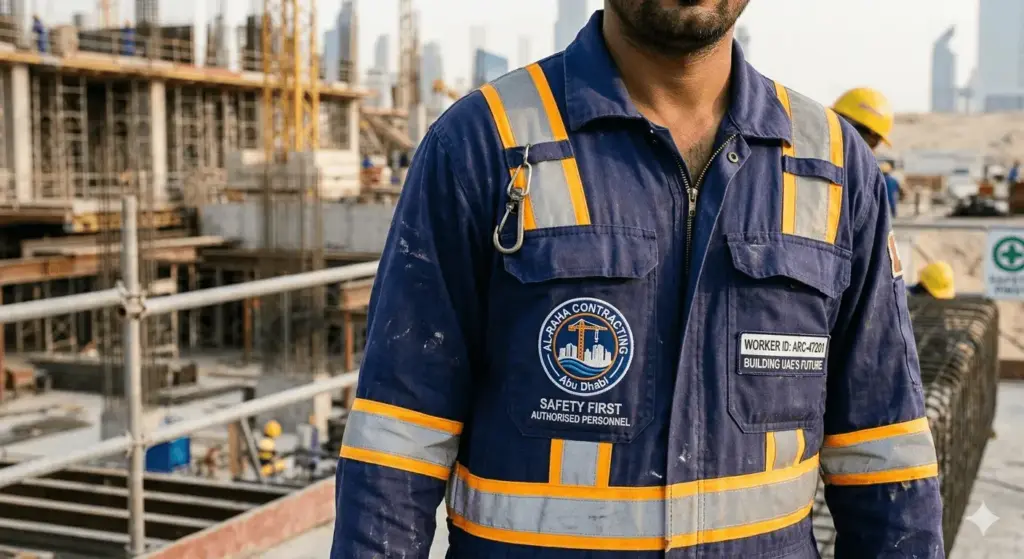
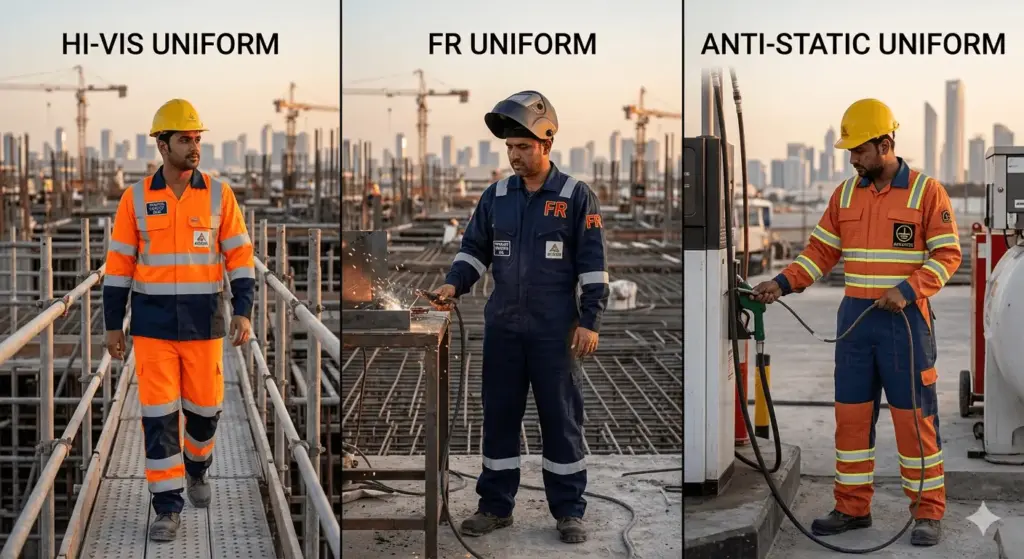
A safety uniform isn’t just a regular outfit with a hi-vis vest thrown on top. Genuine protective workwear is engineered for specific hazards. Here’s a breakdown of the main categories:
High-Visibility (Hi-Vis) Clothing
For workers near vehicles, heavy machinery, or operating in low-light conditions. Hi-vis garments must meet EN ISO 20471 standards — reflective tape placement, color intensity, and total surface area all matter. A faded yellow vest from five years ago doesn’t cut it anymore.
Flame-Resistant (FR) Uniforms
Essential for oil and gas sites, welding environments, and any area with open flame or flash fire risk. FR fabrics are treated or constructed to self-extinguish — significantly reducing burn injuries. These need to be certified, not just labeled.
Anti-Static Workwear
If your team works around fuel handling, electronics manufacturing, or chemical storage, static discharge is a real risk. Anti-static uniforms use specially constructed fabrics that safely dissipate electrical charge before it becomes a hazard.
Coveralls and Heavy-Duty Workwear
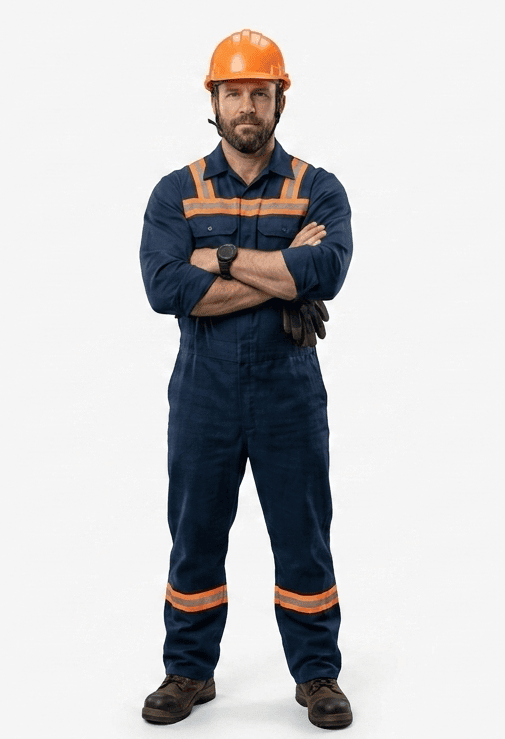
For mechanics, maintenance crews, and factory workers who need full-body protection from abrasion, oil, and grime. Fit matters enormously here — a coverall that’s too loose is a machinery hazard waiting to happen.
PPE-Compatible Designs
Good industrial uniforms are designed to work with your PPE — hard hats, gloves, safety boots, harnesses — not against them. Poorly designed workwear creates gaps, restricts movement, or reduces the effectiveness of other protective gear. View our full range of safety wears
The UAE Heat Problem: Why Fabric Choice Can Save Lives
Here’s something that doesn’t get talked about enough.
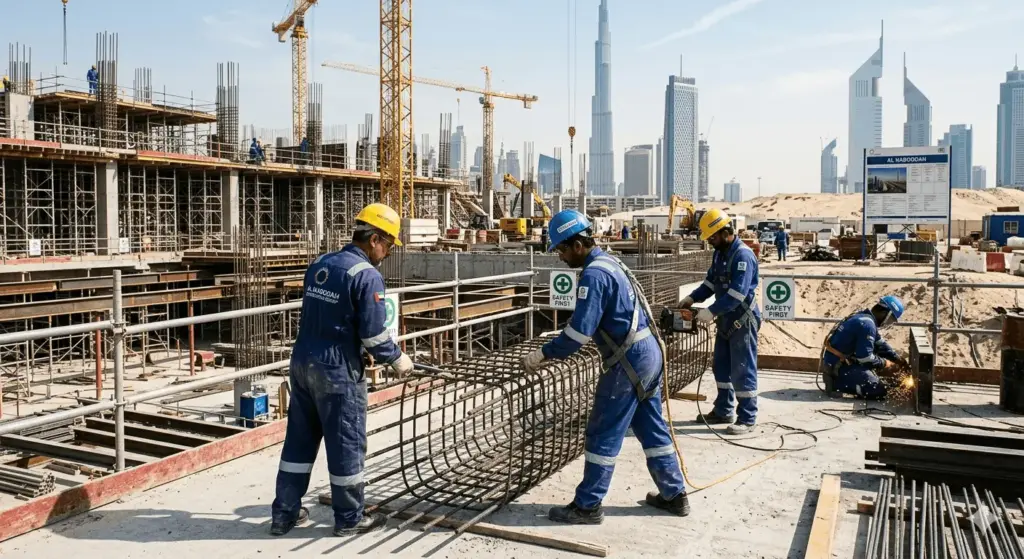
The UAE summer regularly pushes outdoor temperatures above 45°C. For workers on construction sites, in warehouses, or moving between vehicles and outdoor locations, heat stress is one of the most serious occupational health risks they face — and it’s entirely manageable with the right workwear.
The UAE enforces an outdoor work ban from 12:30pm–3:00pm during the summer months. But even outside those hours, in the early morning or evening, the wrong fabric makes everything worse.
What to look for in UAE-appropriate industrial workwear:
- Moisture-wicking blends that pull sweat away from the skin
- Lightweight fabrics that allow airflow without sacrificing coverage
- Light colors where safety standards allow (lighter colors reflect heat rather than absorb it)
- Breathable weaves that work even when layered with PPE
The good news? Modern fabric technology means you don’t have to choose between protection and comfort. Certified FR fabrics now come in lightweight, breathable constructions that perform in the Gulf heat without making workers feel like they’re wrapped in plastic.
UAE Compliance: Are You Actually Meeting the Standards?
Let’s walk through the key compliance questions every UAE industrial business should be asking right now.
Are your fabrics certified? “Safety uniform” labels mean nothing without certification. Ask your supplier for documentation — EN ISO standards for hi-vis, relevant FR ratings, or anti-static certification as appropriate to your sector.
Are your uniforms fit for your specific hazard profile? A construction site and a chemical facility have very different risks. One set of uniforms doesn’t cover both. Map your actual workplace hazards before you specify any garment.
Are you maintaining replacement schedules? FR fabrics lose their protective properties over time — particularly after excessive washing or physical wear. If your team is still wearing coveralls from three years ago, those garments may no longer be providing the protection you think they are.
Are all workers covered — including subcontractors? On complex UAE project sites, subcontractor workers sometimes show up in non-compliant workwear. During a MOHRE or free zone inspection, that’s still your problem if they’re on your site.
Branding on Industrial Uniforms: Practical, Not Just Pretty
Some businesses see branded workwear as a vanity exercise. In an industrial context, it’s actually a safety and operational tool.
Here’s why it matters:
- Site access control — Clearly branded, color-coded uniforms make it instantly obvious who belongs on a site and who doesn’t. This is especially important on large multi-contractor UAE project sites.
- Role identification — When an emergency happens, response time depends on quickly identifying supervisors, safety officers, and first aiders. Labeled or color-differentiated uniforms make this possible at a glance.
- Client confidence — When your branded team walks onto a client’s premises looking uniform, professional, and identifiable, it tells a story about how you run your business.
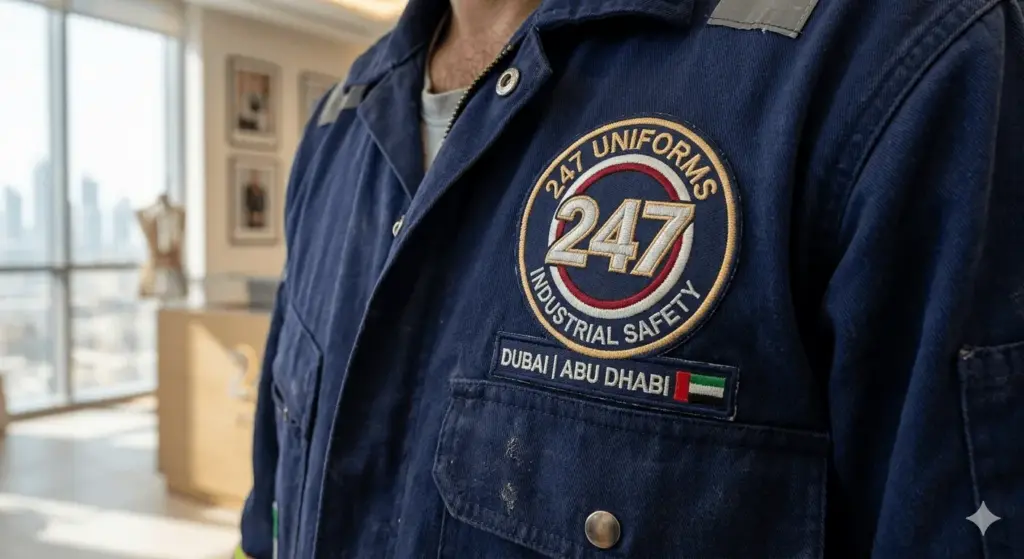
Logo embroidery works effectively on most safety fabrics. For larger prints or high-contrast role identifiers, screen printing and heat-transfer options are also available — without compromising the garment’s protective rating. see examples of our branded industrial work in our portfolio
5 Practical Steps to Get Your Industrial Uniforms Right
If you’re starting from scratch or doing a full refresh, here’s a clear path forward:
Step 1: Map your hazards Before you talk to any supplier, list every physical risk your workers face on site — heat, fire, electrical, chemical, traffic, machinery. This is your specification brief.
Step 2: Choose certified fabrics Match each hazard to the appropriate certified fabric type. Don’t accept a supplier’s word alone — ask for the paperwork.
Step 3: Get sizing right across your whole team Industrial uniforms that don’t fit are a safety risk. Ensure proper measurements are taken, and that options are available for different body types and gender-appropriate cuts.
Step 4: Brand consistently Decide on logo placement, role identifiers, and color-coding before production. Consistency across your entire team matters.
Step 5: Build a replacement schedule Set calendar reminders for uniform audits. Inspect for wear, fading, and protective degradation — and replace proactively, not reactively.
Real-World Example: What Good Industrial Workwear Looks Like
Imagine a mid-sized MEP contracting company operating across three sites in Abu Dhabi. They have electricians, pipe fitters, and site supervisors — all with different risk profiles.
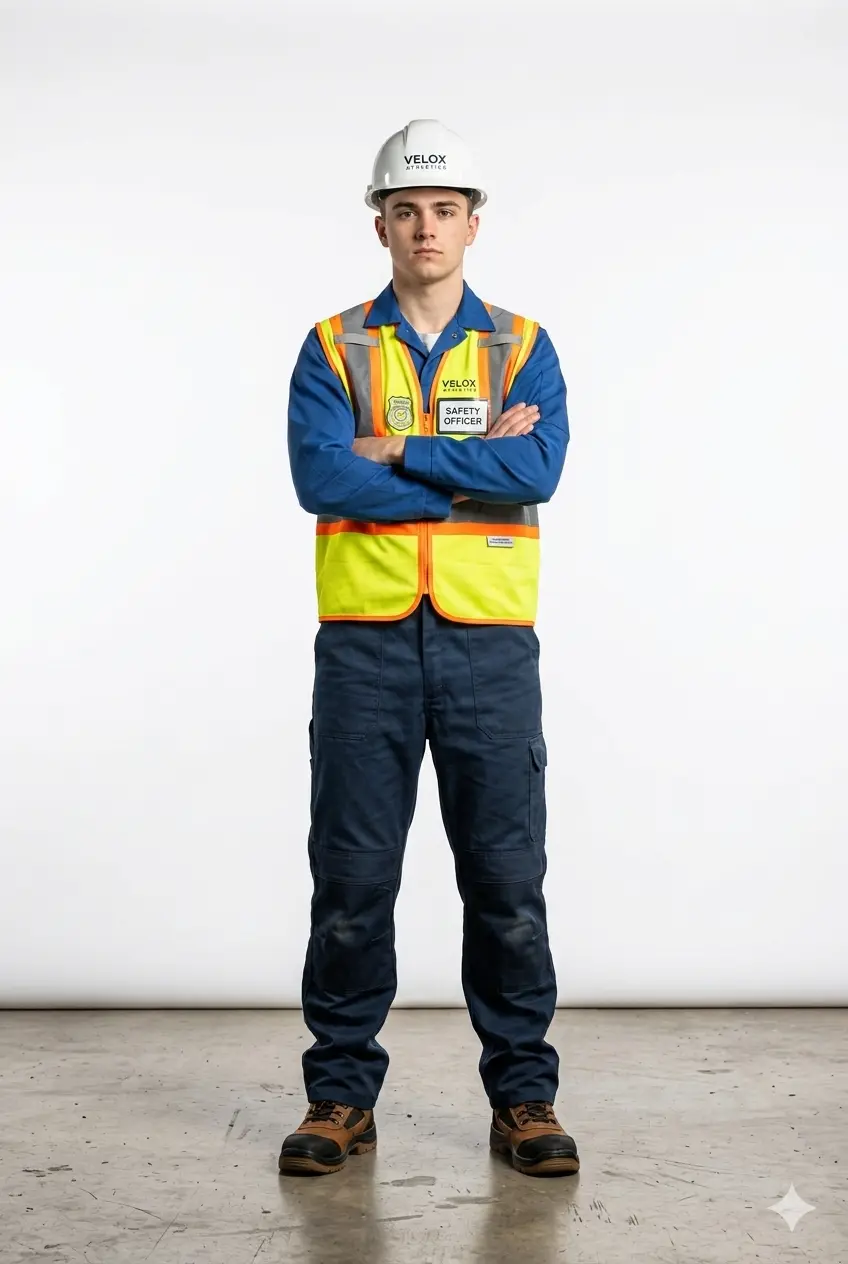
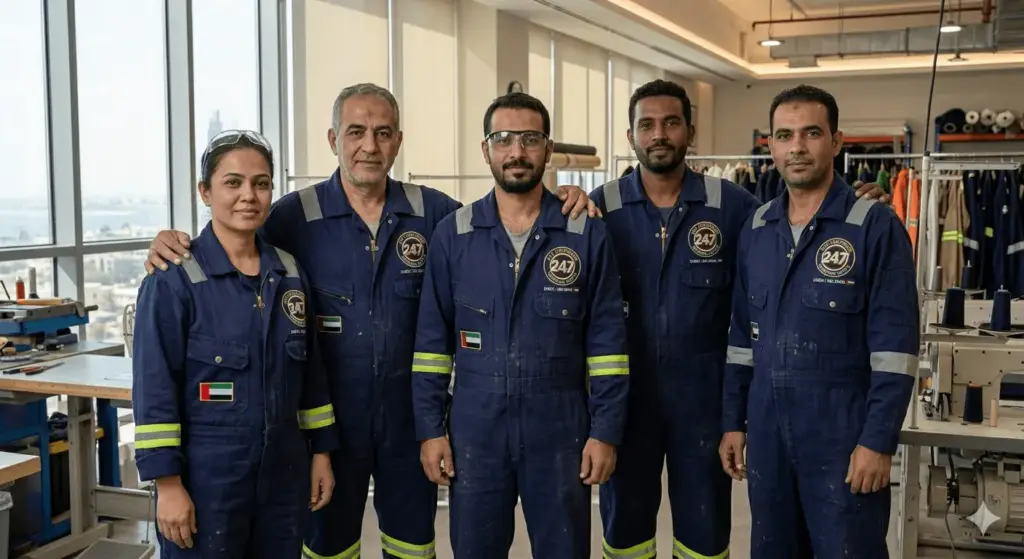
Their uniform system works like this: all workers wear the same branded navy coverall as their base. Electricians wear anti-static variants; site supervisors add a hi-vis orange vest with a printed “SUPERVISOR” identifier on the back; workers in areas near welding wear FR-rated versions of the same coverall. Everything is the same brand color, same logo placement — but each role has exactly the protection it needs.
That’s what a well-designed industrial uniform system looks like. Unified branding, role-specific protection.
Frequently Asked Questions (FAQs)
Q: Are industrial safety uniforms legally required in the UAE?
Yes. UAE labor law and sector-specific regulations require employers to provide appropriate protective clothing for workers in industrial, construction, and hazardous environments. Non-compliance can result in fines and site shutdowns during inspections.
Q: What is the minimum safety standard for hi-vis uniforms in the UAE?
Hi-vis garments should meet EN ISO 20471 standards, which specify minimum reflective surface areas, color requirements, and visibility performance levels. Always ask your supplier for certification documentation.
Q: How often should industrial uniforms be replaced?
This depends on usage and fabric type. As a general guide, heavily worn daily uniforms should be reviewed every 6–12 months. FR-rated garments should be inspected for washing degradation regularly — most manufacturers provide a maximum wash cycle recommendation.
Q: Can I get branded industrial uniforms with my company logo in the UAE?
Absolutely. Logo embroidery and printing are both available on most industrial fabric types without compromising protective ratings. A good UAE supplier will guide you on the best branding method for your specific garments.
Q: What’s the best fabric for outdoor workers in the UAE summer heat?
Look for lightweight, moisture-wicking blends — polyester-cotton performance fabrics are a popular choice. For workers who also need FR protection, lightweight certified flame-resistant fabrics are now widely available and perform significantly better in heat than older FR options.
Q: What is the minimum order quantity for industrial uniforms in the UAE?
This varies by supplier. At 247 Uniforms, the minimum order is just 10 pieces — making it accessible for small contracting teams as well as large enterprise operations.
Q: Does UAE law cover subcontractor workwear on my site?
In most cases, the principal contractor or site owner carries responsibility for overall site safety compliance — which includes ensuring all workers present, including subcontractors, are wearing appropriate protective clothing.
Conclusion: Get It Right Before You Need It
The best time to sort your industrial uniform program is before an incident, before an inspection, and before the summer hits.
In 2026, the UAE’s industrial sector is operating in a higher-scrutiny environment than ever before. Regulators are more active, clients are more demanding, and workers are more aware of their rights — including the right to appropriate protective workwear.
Getting your industrial uniforms right isn’t complicated. It just requires working with a supplier who understands the UAE market, knows the relevant standards, and can deliver certified, branded, well-fitting workwear on time.
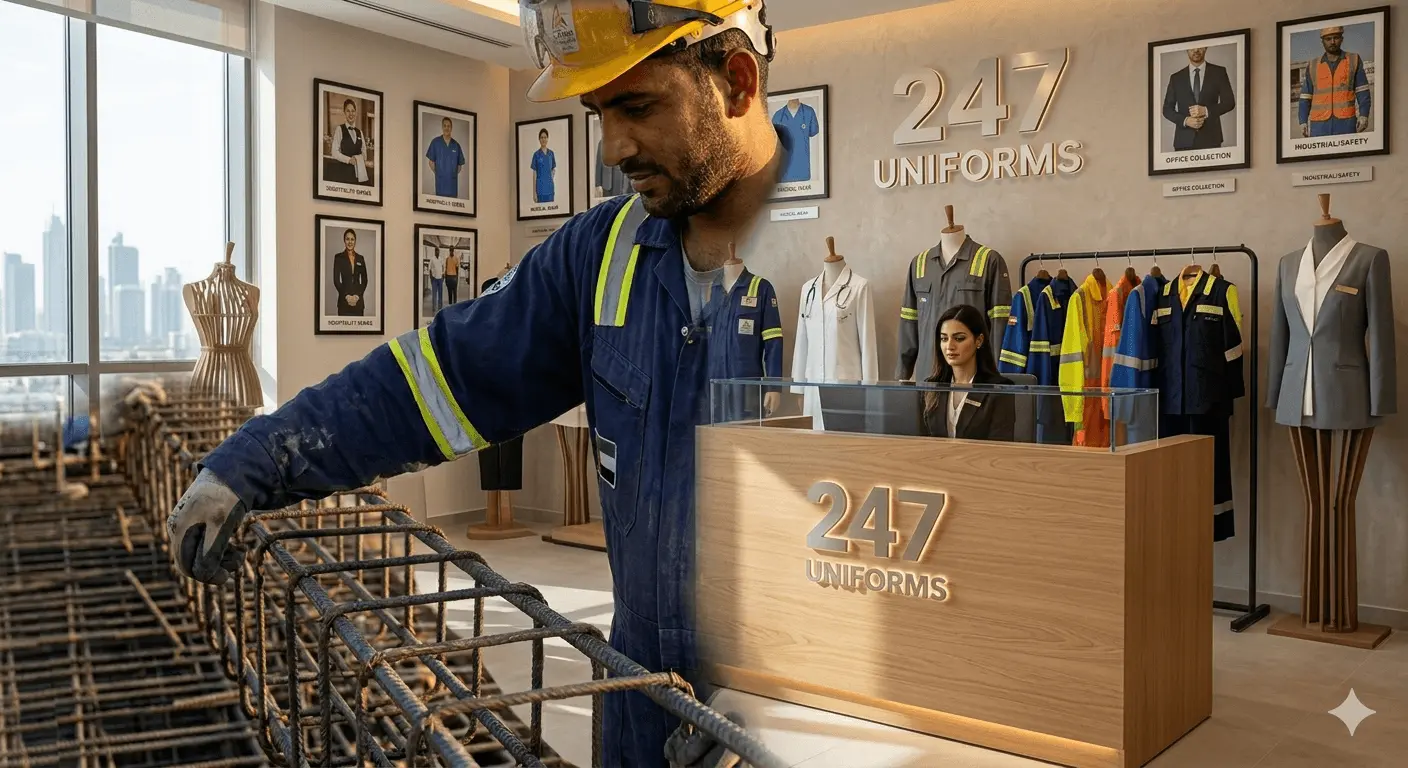
That’s exactly what 247 Uniforms does — and has been doing for over 13 years for 500+ businesses across Abu Dhabi, Dubai, and the GCC.
📦 Ready to Outfit Your Industrial Team?
Tell us your team size, sector, and hazard requirements — we’ll come back within 24 hours with fabric options, pricing, and a free 3D design preview.
Get Your Free Quote → 247uniforms.ae/request-a-quote
Or call us directly: 025 463 873 / 026 622 770




One comment
125Win_oi5
So my friend told me about this platform like two weeks ago and I was skeptical at first but then I actually went on there and spent some time exploring it and now im kinda hooked on how straightforward everyting is set up. [url=https://125-win.com/]125win app[/url]